
What does it actually mean for a government or institution to listen to the people it serves? And why do institutions often collect enormous amounts of public feedback without meaningfully responding to it?
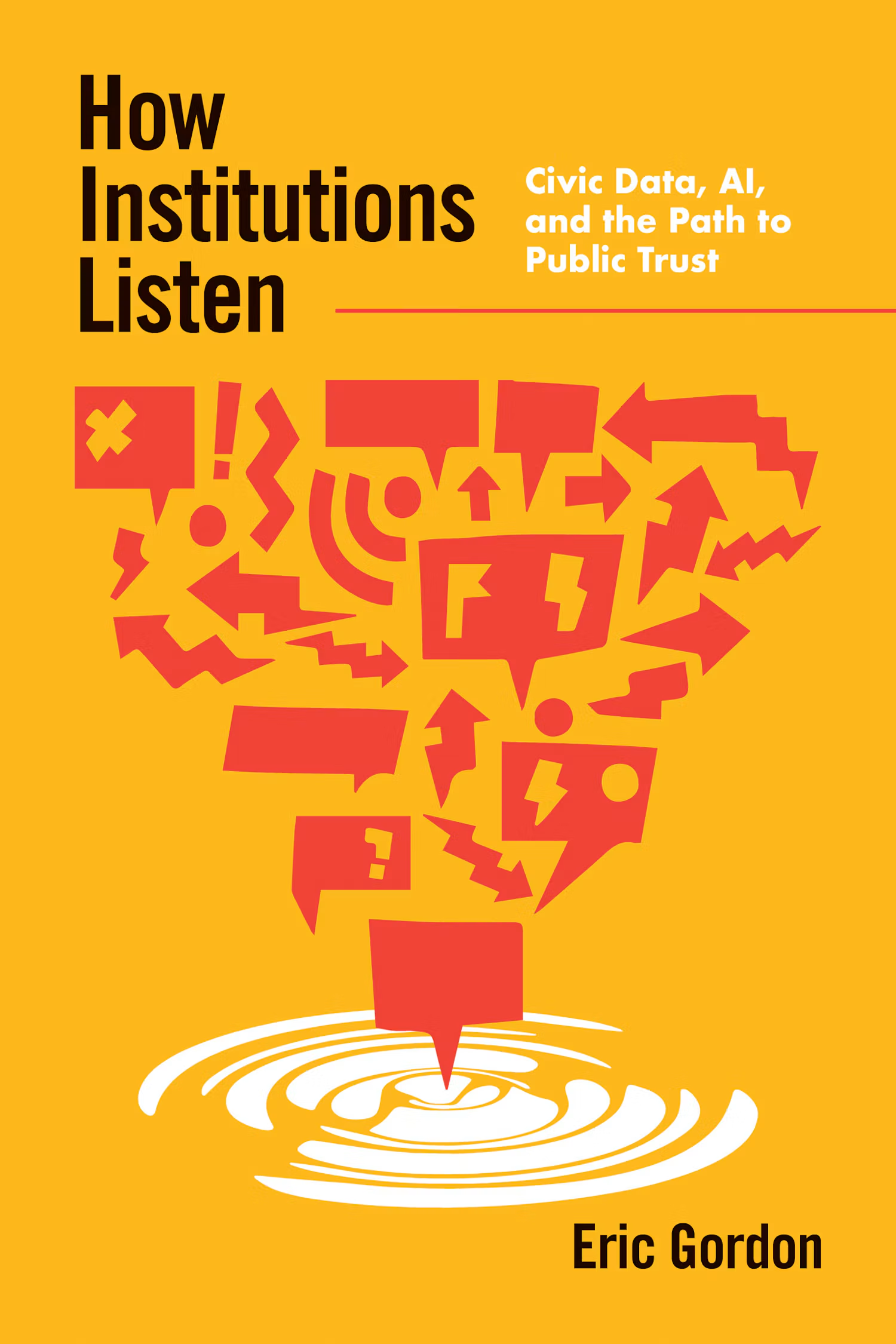
In episode 473 of The Armen Show, I speak with Eric Gordon, author of How Institutions Listen: Civic Data, AI, and the Path to Public Trust, about the relationship between public institutions, the communities they represent, and the technologies that could help improve that relationship.
Eric explains that the problem is often not a lack of public participation or good intentions among government employees. Instead, institutions frequently lack the infrastructure, incentives, and accountability mechanisms needed to turn information into better decisions. Public meetings, surveys, and consultations can become exercises in participation without producing meaningful changes.
We explore the idea of listening at scale, including why genuine listening requires institutional memory, reciprocity, and the capacity to change in response to new information. Just as people lose trust in someone who repeatedly forgets what they’ve been told, communities lose confidence in institutions that continuously ask for feedback without demonstrating that they’ve learned anything.
We also discuss how artificial intelligence could help governments make sense of large amounts of public dialogue, while raising important questions about surveillance, privacy, transparency, and the concentration of power.
Topics discussed include:
- Why public participation sometimes becomes political theater rather than meaningful engagement.
- The difference between collecting information and genuinely understanding and responding to people.
- Why institutional memory matters for maintaining public trust.
- How political incentives and bureaucratic structures prevent departments from sharing information.
- The civic data pipeline: data collection, analysis, and use.
- How AI can help interpret large-scale public conversations and community feedback.
- The distinction between institutional listening and surveillance.
- Procedural justice and why people may accept decisions they disagree with when they trust the process.
- How power imbalances influence trust between governments and citizens.
- The opportunities and risks of AI in public institutions, including the need for appropriate safeguards and regulation.
Eric shares several examples of these ideas in practice, including a large-scale civic imagination project in Bowling Green, Kentucky, the use of social media monitoring in Pittsburgh, Pennsylvania, and community data walks in Evanston, Illinois. These cases illustrate how data can become more useful when communities participate not only in providing information but also in interpreting it.
A central theme of our conversation is that better institutions are not simply those that gather more information, but those that can remember, understand, and act responsibly on what they learn.
The discussion connects political institutions, human communication, technological change, and democratic accountability, examining how the relationship between governments and the public might evolve as new forms of intelligence and data analysis become available.
Book: How Institutions Listen: Civic Data, AI, and the Path to Public Trust by Eric Gordon.
Topics: Civic Technology, Artificial Intelligence, Public Trust, Government, Democracy, Communication, Institutional Design
Podcast: Play in new window | Download
Leave a Reply